Open to new opportunities

I like building things.

I’m James, a full-stack engineer and founder building local-first AI tools, payment infrastructure, and interfaces that make complex systems usable.

Payments, rethought.

Less friction.
More possibility.

AmanuCash brings passkeys, stablecoins, and ultrasound payments into one everyday experience.

Inside AmanuCash Co-founder & CTO · Product + engineering
AmanuCash
AmanuCash wallet and local payment experience
12+ wins Across blockchain hackathonsConsensus ’24 1st & 5th placeAmanuCash Co-founder & CTO
Selected work

A closer look.

The products, the problems,
and the engineering behind them.

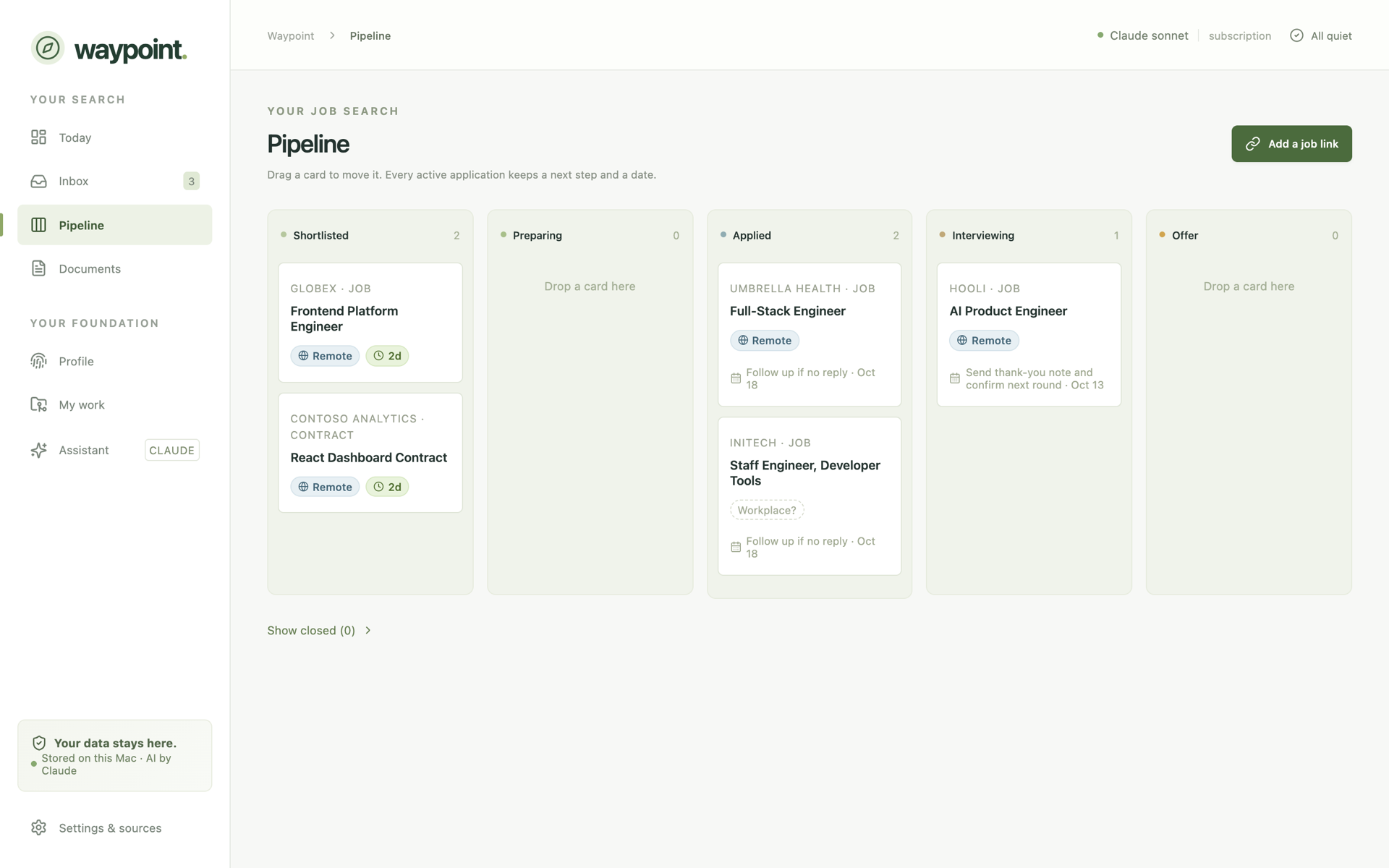
Waypoint · Applied AIWaypoint pipeline board with shortlisted, applied, and interviewing opportunities and scheduled follow-ups
Applied AI / Full-stackLocal-first

Waypoint

A private, Claude-powered job-search command center.

Watches company and remote job boards, scores listings against a candidate profile with Claude, drafts tailored resumes, cover letters, and proposals, and keeps a pipeline moving with daily actions and automatic follow-ups.

  • React + TypeScript
  • Express
  • SQLite
  • Claude Code
AI integration
Headless Claude with every tool disabled
Engineering depth
Backend, privacy, and browser tests
Inside the engineering

The problem

A serious job search means tracking many boards, tailoring every application, and remembering follow-ups, without handing a résumé and pipeline to another cloud service.

What I built

Source adapters for Greenhouse, Lever, Ashby, and remote job boards; an inbox with keyboard triage; a drag-and-drop pipeline; evidence-grounded scoring and drafting; offline PDF export; and calendar export for follow-ups.

Engineering decisions

Listing text is treated as untrusted: Claude runs headless with no tools, MCP servers, or saved session. Public fetches pin DNS and reject private addresses, the local API checks a session token, Host, and Origin, and drafts check citations and withhold unsupported numbers.

Current scope

A local application for macOS. Generated materials remain drafts for review before sending.

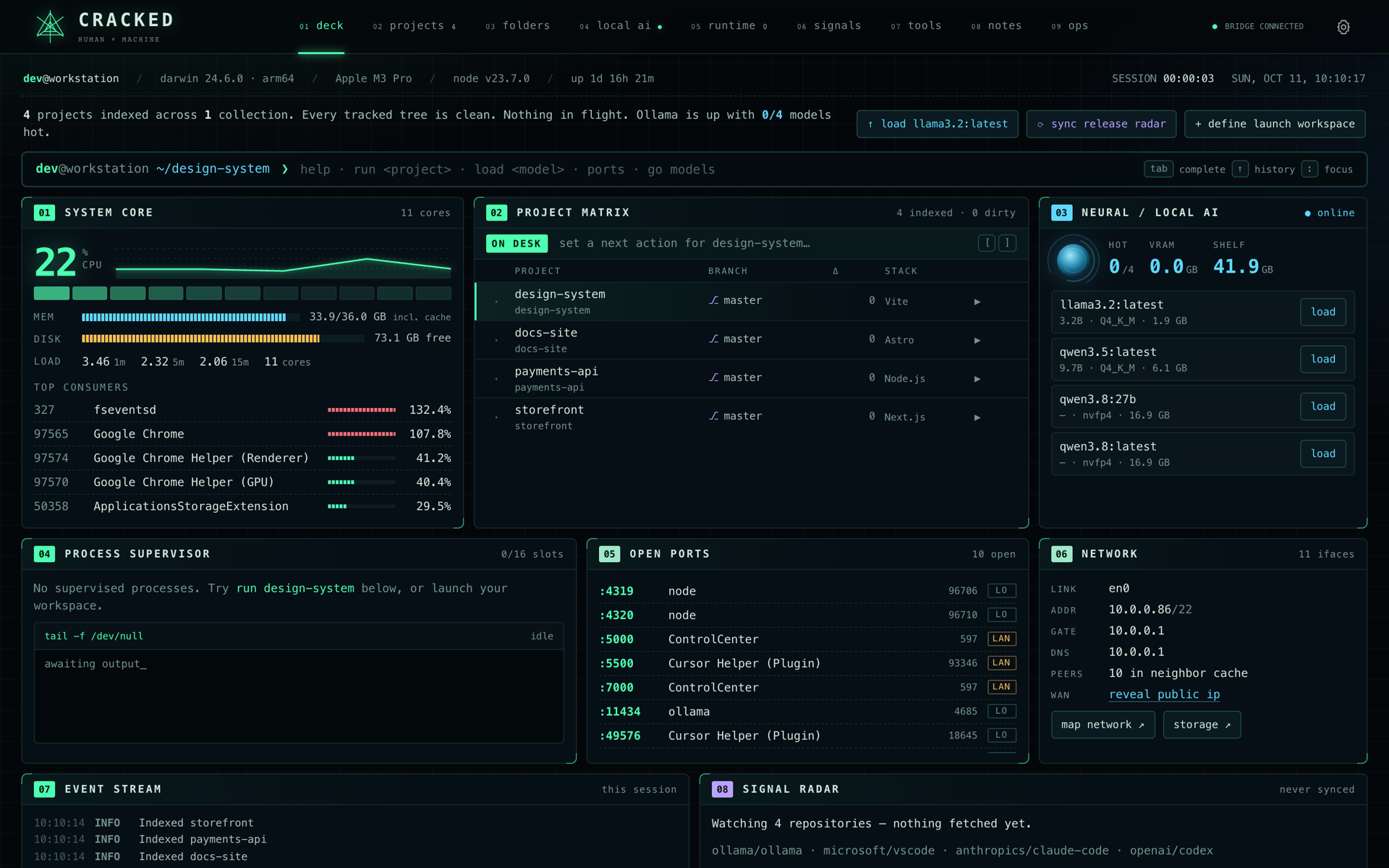
CRACKED · Developer toolsCRACKED command deck showing system usage, a project matrix, local AI models, open ports, and network status
Developer tools / Local AIZero dependencies

CRACKED Command Center

An engineering dashboard for everything on my machine.

A local command deck that discovers projects, runs and supervises their scripts, manages Ollama models, and shows live machine, port, and network state, with a command line and palette for moving fast.

  • Node.js
  • Vanilla JS
  • Ollama
  • Git
Scope
Nine workspace views, one command palette
Principle
Shows only real local state
Inside the engineering

The problem

Running many projects means juggling terminals, ports, local models, and disk space across separate tools.

What I built

Project discovery with framework and package-manager detection, Git status, script runners with live output and process-group control, launch workspaces, Ollama model management, a GitHub release radar, storage analysis with reversible quarantine, and a bookmarks and notes vault.

Engineering decisions

A single Node server with no runtime dependencies and a token-protected local API. It works offline and never fabricates processes, models, or measurements.

Local-first AI / Desktop applicationOpen source

Foldur

A personal intelligence layer over AI conversation history.

Built a Tauri and React desktop app that normalizes chat exports, indexes them in SQLite, and surfaces projects, themes, and recommendations. Optional Ollama integration adds local model analysis.

  • Tauri
  • React + TypeScript
  • SQLite FTS
  • Ollama
System design
Adapters → pipeline → storage → UI
Engineering depth
Typed schemas, migrations, import tests
Inside the engineering

The problem

Useful ideas and decisions get buried across AI conversations. Recovering them should not require sending the entire archive to another cloud service.

What I built

ChatGPT and generic import adapters, a canonical data model, chunking and indexing, project and theme views, and an optional local Ollama provider. The repository separates domain types, adapters, database repositories, pipeline stages, and the desktop UI.

Engineering decisions

SQLite for local storage and full-text search; explicit provider interfaces for model integration; architecture records and tests around import and database boundaries.

Current scope

Some extraction uses heuristics. Dedicated Claude and Cursor adapters, encrypted storage, and a remote model provider remain on the roadmap.

XRPLFlows · Visual toolsXRPLFlows canvas connecting conditional, escrow, and multisignature payment blocks
Developer tools / Blockchain

XRPLFlows

A visual programming environment for payments.

A visual flow builder for composing payment logic on the XRP Ledger. Drag, connect, and configure blocks to express financial workflows.

  • XRPL
  • Visual programming
  • Payment workflows
Engineering focus
Composable payment logic
Interface
Drag-and-drop workflow canvas
Behind the build

The problem

Payment conditions and dependencies become difficult to follow when the logic lives only in code.

My contribution

Built a drag-and-drop application that exposes payment primitives as configurable blocks, allowing users to compose more complex flows visually.

Visit project
Off-Ramp Widget · FintechOff-Ramp Widget interface for converting stablecoins into fiat
Full-stack / Fintech

Off-Ramp Widget

A reusable bridge between wallets and banking.

A reusable React widget integrating Privy email-based wallets with Blindpay receiver onboarding, bank-account forms, withdrawal quotes, and token-approval flows on Base Sepolia testnet.

  • React + TypeScript
  • Privy
  • Blindpay
  • Base Sepolia
Engineering focus
Wallet + payment integration
Interface
Configurable payment widget
Behind the build

The problem

Moving between stablecoins and traditional banking adds unfamiliar wallet and identity steps.

My contribution

Built the widget around Privy’s email OTP wallets, bringing authentication and the conversion flow into a configurable interface.

Explore the code
Privacy / Developer infrastructureOpen source

stealth-eth

Ethereum stealth-address primitives in a TypeScript SDK.

Built key generation, meta-address encoding, one-time address derivation, and announcement matching behind a framework-independent API, with a CLI and tests for the sender-to-recipient flow.

  • TypeScript
  • secp256k1
  • Stealth addresses
  • Vitest
API design
Separate viewing and spending capabilities
Scope
Local cryptographic core + CLI
Inside the engineering

The problem

Reusing a public payment address makes activity easier to associate. Stealth addresses let senders derive a new recipient address for each payment.

What I built

Typed utilities for key generation, meta-address parsing, address derivation, announcement checks, private-key recovery, and batch scanning. A view-only scanning API detects matching announcements without taking a spending key.

Test coverage in the repository

Key generation, malformed meta-addresses, address matching, private-key derivation, mixed announcement batches, and view-only scanning have dedicated tests.

Integration boundary

The SDK performs local cryptographic operations. Applications supply their own chain client, announcement indexing, transaction signing, and gas handling.

LLMs, tools & engineering judgment

More ideas
within reach.

I combine LLM-assisted development with explicit architecture, repository rules, and small, reviewable changes. Foldur brings that approach into a local-first desktop application with optional on-device model integration.

My focus is the whole development loop: useful context, well-scoped tools, reviewable changes, and validation. The goal is to get from an idea to working software faster, with a clear understanding of what was built.

How I approach the workflowDefine → Build → Verify → Refine
  1. 01

    Set the context.

    Make the problem, constraints, repository conventions, and definition of done explicit before asking a model to act.

  2. 02

    Connect the tools.

    Use a harness to connect model output with the editor, terminal, and project tools. Keep tasks scoped and changes reviewable.

  3. 03

    Verify the result.

    Review code, run relevant checks, and exercise the actual user flow. Model output is a starting point for engineering review.

  4. 04

    Improve the loop.

    Turn useful patterns into reusable instructions and workflows. Refine the approach when a tool, prompt, or assumption falls short.

Applied in product work

The engineering process is in the repository.

Foldur includes repository rules for architecture, privacy, and task sizing, alongside feature specs, build logs, and tests for adapters and import pipelines. The repository makes both the product and the development process inspectable.

Explore Foldur
Hackathons & recognition

Recognized for
what I build.

12+
Hackathon winsPayments. Wallets. New interfaces.

Over 12 hackathon wins, with a recurring focus on making complex payment systems easier to use. A few highlights:

Consensus 2024

1st & 5th place

Rootstock · Polkadot

Ultrasound payments
& NFT airdrops.

Built payment and airdrop experiences using ultrasound, bringing onchain interactions into the physical world.

Ultrasound · Payments · NFTs
Circle

Winner

Stablecoin payments

A payment interface
inside the keyboard.

A custom device keyboard for sending stablecoins and sharing payment links, built around the way people already communicate.

Custom keyboard UI · Payment links
Avalanche · Filecoin · Circle

Winner

Consumer payment experience

Apple Pay-style UX.
Stablecoins underneath.

A familiar consumer payment experience built with stablecoins, making blockchain payments feel more approachable.

Stablecoins · Wallet UX
James Garinger
A little about meJames GaringerEngineer. Founder. Always learning.

Curious by default.
Hands-on by choice.

The hardest part of building is finding a product people need.

I’ve worked across startup products, client websites, blockchain payments, and AI interfaces. The thread through all of it: understanding the problem, getting something working, and learning from the people using it.

I like being close to both the code and the product decisions. I’m looking for a team where I can take ownership, keep learning, and build useful things with thoughtful people.

The longer story on LinkedIn
What I build with
01

Interfaces & applications

TypeScript, JavaScript, React, Next.js, Tailwind CSS, React Native

02

Services & data

Node.js, Express, SQLite, PostgreSQL, MongoDB, WebSockets

03

Wallets & onchain systems

Solidity, ethers.js, viem, XRPL, IPFS, ERC-4337, Privy

04

AI-powered interfaces

Local model integration, Ollama, import pipelines, retrieval, and conversational interfaces

Experience

Ownership at every stage.

From product direction and implementation
to testing, delivery, and customer feedback.

2025 — Present

Contract engineering

Full-stack engineerSmall-team blockchain startups

Payment flows for early blockchain teams.

Work as a contract full-stack engineer embedded with small blockchain startup teams, building wallet onboarding, currency swaps, payment routing, and payment experiences across the interface, backend, and on-chain integrations. Stack: React, TypeScript, Node.js, viem, and Solidity on Base.

  • Built the swap and routing flow for a seed-stage stablecoin payments startup, picking the cheapest path across three liquidity sources.
  • Shipped passkey wallet onboarding for a consumer crypto app, taking new users from sign-up to a funded wallet in under a minute.
  • Owned the checkout and payment-status experience for a merchant payments team of four engineers.
2023 — 2024

SigVerify

Founding engineerDocument systems & blockchain

Built document workflows with verifiable state.

Shipped an MVP using XRPL and IPFS for smart documents with conditional logic and signer-level visibility. Contributed to investor and grant presentations and helped secure acceptance into XRPL Commons.

  • Connected document permissions, conditional logic, and decentralized storage.
  • Worked across implementation and early-stage product communication.
2021 — 2023

JGFreelance

Owner / Full-stack developerClient delivery, end to end

Owned the work beyond the code.

Delivered websites and applications while managing sales, scoping, contracts, development, and deployment. Turned client needs into working interfaces using React, Next.js, and Node.js.

  • Handled the handoff from a business problem to a deployed solution.
Have something in mind?

Let’s make
something matter.

I’m exploring full-stack, product engineering, and applied AI roles—as well as blockchain teams solving real problems.

Start a conversation
Open to opportunitiesjkggaringer@live.com

Project screenshot